Two months ago, a chain of mid-size supermarkets in Southern Europe asked us to quote an electronic shelf label rollout for 22 stores. Their procurement team had already been pitched three different systems - one running Bluetooth LE, one on Wi-Fi, and one on proprietary 433 MHz radio. Each vendor claimed theirs was the best. None explained under what conditions it was actually the worst. That conversation convinced us to write this piece.
Three wireless protocol families dominate ESL deployments right now: Bluetooth Low Energy (BLE, especially since the 5.4 specification), Wi-Fi, and Sub-GHz radio (433 MHz in Asia, 868 MHz in Europe, 915 MHz in North America). Each protocol solves a real problem. Each creates tradeoffs that vendor brochures underplay. Here is what we have seen across real store environments.
Bluetooth LE: Open Standard, Still Maturing at Scale
Bluetooth has serious momentum behind it. The Bluetooth SIG published a dedicated ESL Profile built on Bluetooth 5.4's PAwR (Periodic Advertising with Responses) feature - a mechanism that lets one access point broadcast commands to thousands of labels in organized time slots, then receive responses without establishing individual connections.

Silicon Labs tested this on a 1,500-node network in their lab. EM Microelectronic shipped the em|bleu SoC at just 1.8×1.8 mm with 200 nA deep sleep current - small enough and frugal enough to fit inside even compact 2.66-inch E-ink tags. With over 5 billion Bluetooth devices shipping annually, component costs benefit from enormous economies of scale.
For retailers, the practical upside is vendor flexibility. An open standard means - at least in principle - that you can mix access points from one supplier with labels from another. That is a meaningful departure from the vendor lock-in that has plagued ESL for years. Sleep currents below 2 µA are typical for BLE ESL chipsets, and the Bluetooth 5.4 spec supports roughly 32,600 labels per access point network on paper.
The catch: "on paper" matters here. Large-scale grocery deployments on BLE are still relatively young compared to proprietary systems that have been running for a decade. Rigado, an IoT gateway vendor active in ESL, puts individual gateway costs at $1,000 to $2,000 installed - and a large supermarket might need ten or more. BLE operates at 2.4 GHz, sharing spectrum with Wi-Fi routers, customer phones, microwaves, and every other wireless device in the building. In a busy store, that congestion can delay price updates during peak hours.
Best fit: pharmacies, boutiques, and mid-size stores under 2,000 m² - especially those already running BLE beacons for asset tracking. Retailers sourcing 5.8-inch BLE-capable shelf labels that update from a tablet without heavy infrastructure will find this protocol appealing.
Wi-Fi: Use Your Existing Network - But Budget for Batteries
The pitch is straightforward: your store already runs enterprise Wi-Fi in every aisle, so skip the new gateways and connect your ESLs directly to the existing network. For large enterprise chains that have already invested heavily in commercial access points with full coverage, the integration math looks attractive.
Wi-Fi also delivers higher data throughput than BLE or Sub-GHz. That advantage becomes tangible when you are pushing rich graphical content - product images, promotional animations - to LCD-based digital price screens rather than simple E-ink tags. A 15.6-inch LCD screen running promotions at an endcap needs bandwidth that E-ink pricing tags do not.
The problem shows up in two places. First, power consumption. Wi-Fi draws significantly more current than BLE or Sub-GHz during each transmission cycle. An E-ink label on Sub-GHz radio might run five to eight years on a coin cell with one to three daily updates. The same label on Wi-Fi? Twelve to eighteen months. At scale - thousands of labels across multiple stores - that means a recurring battery replacement program your operations team has to resource. Second, network congestion. Wi-Fi ESLs compete for airtime with POS terminals, customer devices, handheld scanners, and self-checkout kiosks. During Saturday afternoon peaks, that competition is not theoretical.
Best fit: enterprise retailers with mature, well-engineered Wi-Fi infrastructure, stores running powered LCD digital signage (where battery life is irrelevant because the screens are plugged in), and deployments measured in hundreds rather than tens of thousands of labels.
Sub-GHz (433/868/915 MHz): No Glamour, Long Range, Long Battery
Sub-GHz radio does not have a marketing body promoting it the way Bluetooth SIG champions BLE. Most Sub-GHz ESL systems run proprietary protocols specific to the label manufacturer. There is no interoperability profile. Switching vendors means replacing the entire communication stack.
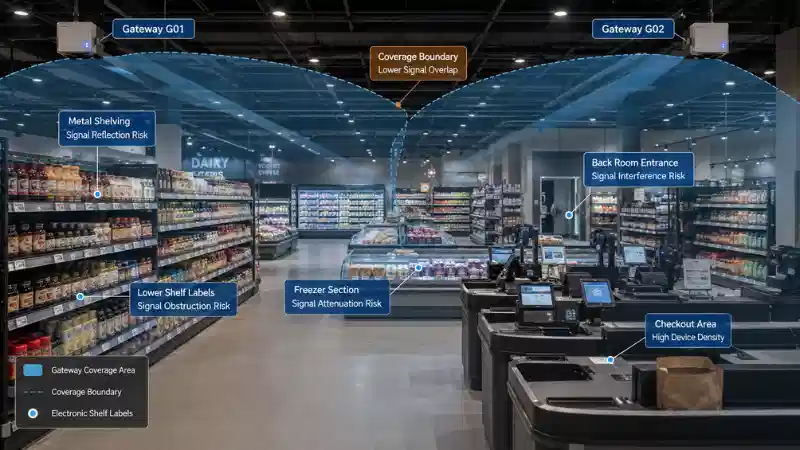
And yet, for certain store formats, the physics make it the most practical choice. Lower frequencies produce longer wavelengths. Longer wavelengths penetrate metal shelving, concrete partition walls, and refrigerated display cases far more effectively than 2.4 GHz signals. Display Data, a UK-based ESL provider, built their entire platform around Sub-1 GHz for precisely this reason - maximum range and signal penetration in complex retail environments. A single Sub-GHz access point covers a significantly larger footprint than its BLE or Wi-Fi equivalent. Fewer access points means lower infrastructure cost and simpler network planning.
Battery life is the other decisive factor. Silicon Labs' ESL design guidance specifies that reaching five to ten years on a CR2032 coin cell requires an average current budget below 10 µA - their Sub-GHz FG22 SoC achieves 0.17 µA in deep sleep. For large-format E-ink labels in warehouse or hypermarket environments with one to three updates daily, Sub-GHz consistently delivers the longest operational life.
Best fit: hypermarkets and big-box retailers above 5,000 m², warehouse and logistics environments with metal racking, cold chain and refrigerated areas, and any deployment where minimizing infrastructure and maximizing battery life take priority over bandwidth. Our clients rolling out E-ink shelf labels across large-format stores consistently gravitate to Sub-GHz.

Side-by-Side Comparison
| Metric | Bluetooth LE 5.4 | Wi-Fi | Sub-GHz (433/868/915 MHz) |
|---|---|---|---|
| Effective In-Store Range | 10–30 m | 15–35 m | 50–200 m |
| Battery Life (E-ink, 1–3 updates/day) | 3–5 years | 1–2 years | 5–10 years |
| Data Throughput | Moderate | High | Low |
| Labels per Access Point | ~32,000 (spec) / hundreds typical | Varies by AP capacity | Thousands per gateway |
| Gateway Cost (installed) | $1,000–$2,000 | Uses existing network | $500–$1,500 |
| 2.4 GHz Interference | Yes | Yes | No - separate band |
| Open Standard | Yes (BLE ESL Profile) | Yes (802.11) | Mostly proprietary |
| Best Store Format | Small–mid retail, pharmacies | Enterprise with strong IT | Hypermarkets, warehouses |
Protocol Choice Ripples Through Your Entire Store
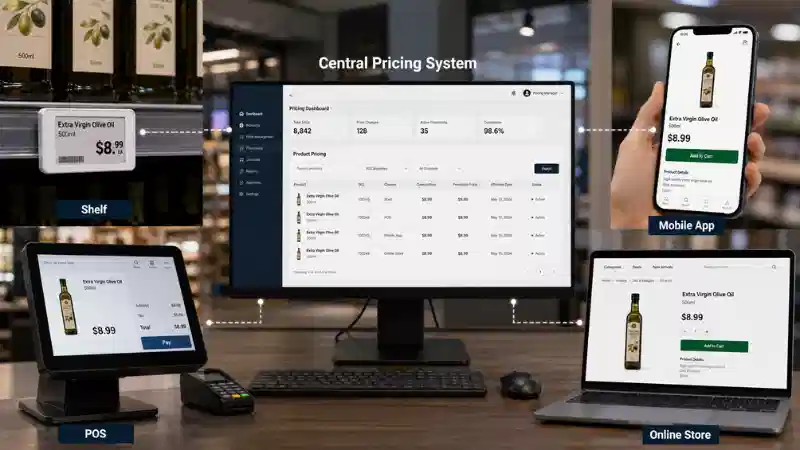
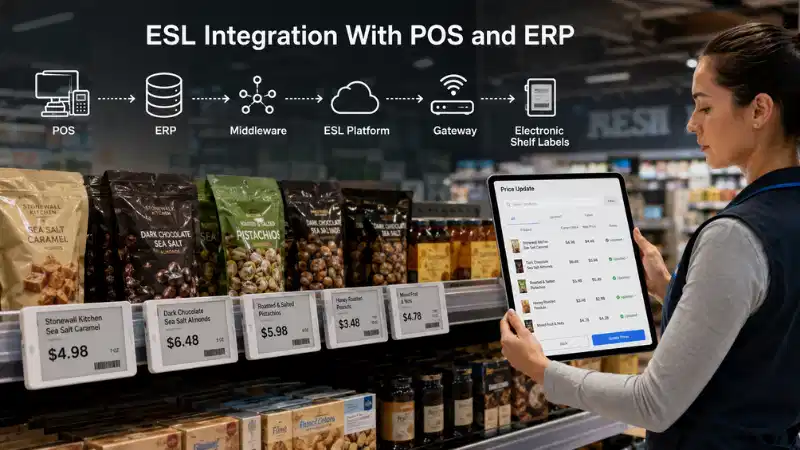
Something the protocol comparison articles consistently miss: your ESL wireless network does not operate in isolation. The access points, the pricing backend, the management software - all of it touches other digital systems in the store. If you are running self-service touchscreen kiosks for checkout, those kiosks pull pricing from the same database. If shelf-edge LCD bar displays run promotions in aisle, the content engine feeding those screens can also trigger campaigns on your E-ink labels - but only if the systems share a common API layer.

We have seen the cleanest results when clients plan their ESL deployment alongside their kiosk and digital signage rollout, not as three separate IT projects. When the price a customer sees on the shelf tag, the endcap LCD screen, and the self-checkout terminal all feed from one source, pricing complaints - the single biggest friction point in grocery - drop close to zero.
Three Questions Before You Commit
What does your floor plan look like? A 400 m² pharmacy and a 12,000 m² hypermarket are different radio environments. BLE handles the first with two or three access points. The second probably needs Sub-GHz to avoid littering the ceiling with gateways.
What content are you displaying? Static prices on E-ink? Any protocol handles that. Video promotions on powered LCD screens? You need Wi-Fi's throughput. Flash pricing that changes multiple times per hour? Confirm your protocol can sustain the update volume without draining batteries prematurely.
What else shares your airwaves? A store already saturated at 2.4 GHz - customer Wi-Fi, IoT sensors, handheld scanners - will struggle with another 2.4 GHz system layered on top. Sub-GHz operates in a less crowded band entirely.
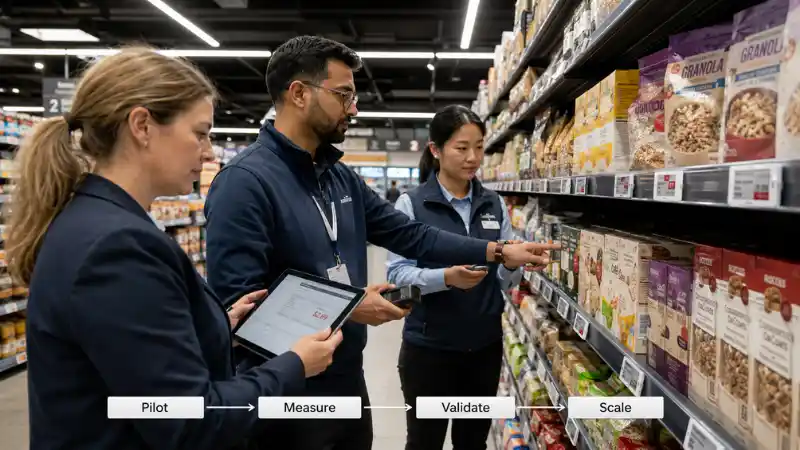
No single protocol is universally best. If your ESL supplier only offers one wireless option and cannot explain where it falls short, that tells you something. If you want to test labels across protocols in your actual store before committing at scale, request evaluation samples - two weeks in one live aisle reveals more than any spec sheet or vendor slide deck.